Lost in Time: Bukhara’s Ancient Soul Will Steal Your Heart
Walking through Bukhara feels like stepping into a living storybook—centuries-old minarets rise beside quiet alleys where merchants once traded silk and spices. I didn’t expect to feel so connected to a place steeped in history. Every courtyard, madrasa, and mosque whispers secrets of the Silk Road’s golden age. This isn’t just travel; it’s time travel. And Bukhara? It’s unforgettable. The city does not shout its significance—it murmurs it in the rustle of wind through carved wooden eaves, in the soft clink of tea bowls at dusk, in the steady gaze of turquoise domes against an endless sky. Here, history is not preserved behind glass but lived in rhythm with daily rituals, making it one of Central Asia’s most profound cultural experiences.
The First Glimpse: Arriving in a City Frozen in History
Upon arrival, Bukhara greets travelers not with the clamor of modern metropolises but with a quiet dignity that settles over the city like morning mist. As visitors pass through the ancient Ark Fortress gates or approach the historic center from the newer districts, the shift is immediate. Wide boulevards give way to narrow cobblestone lanes shaded by mulberry trees, their canopies filtering sunlight into dappled patterns on centuries-old brickwork. The air carries the faint scent of baking non, the traditional Uzbek flatbread, mingling with the dry earthiness of sunbaked adobe. Horse-drawn arbas—wooden carts used for centuries—clatter gently along alleyways, offering a rhythmic counterpoint to the silence of stone.
What strikes most profoundly is how seamlessly the past and present coexist. A woman in a floral headscarf might step out of a 12th-century courtyard to check her mobile phone, while children chase each other beneath archways that once framed caravans laden with Persian carpets and Chinese porcelain. There are no artificial reconstructions or theme-park facades—this is authentic continuity. The UNESCO World Heritage designation of Bukhara’s historic center in 1993 was not an act of preservation alone, but an acknowledgment of its living heritage, where architecture is not merely admired but inhabited.
For many, the first true encounter with the city’s soul happens at Lyabi-Hauz, a shaded plaza centered around a historic pool reflecting the surrounding wooden balconies and tiled domes. Though the city has expanded outward, this area remains the emotional and spiritual nucleus. It is here that the weight of centuries becomes tangible—not as a burden, but as a gentle presence. Travelers often pause, sensing they have entered not just a different place, but a different tempo of life. Time slows. Attention sharpens. And the journey inward begins.
The Heart of Bukhara: Poi-Kalyan and the Grand Ensemble
At the core of Bukhara’s historical and spiritual identity lies the Poi-Kalyan complex, a masterpiece of Islamic architecture that has stood for over 800 years. The name itself means 'foot of the Great,' referring to the towering Kalyan Minaret that dominates the skyline. Rising 47 meters with a conical spire and intricate brickwork spiraling upward like a stone helix, the minaret was once used to call the faithful to prayer and, according to legend, also served as a platform from which disobedient criminals were cast down—a grim reminder of justice in medieval times. Yet today, it stands as a symbol of endurance, having survived Mongol invasions, fires, and the passage of empires.
Surrounding the base of the minaret is the full ensemble: the Kalyan Mosque, the Mir-i-Arab Madrasa, and the former site of the demolished Kalon Mosque, now an open courtyard. Together, they form a harmonious architectural quartet that has drawn pilgrims, scholars, and travelers for generations. The Kalyan Mosque, rebuilt in the 16th century, could accommodate up to 10,000 worshippers, its vast prayer hall supported by rows of squat columns and crowned with domes of azure tile. Though no longer used for daily prayers, its scale and serenity leave a lasting impression on all who enter.
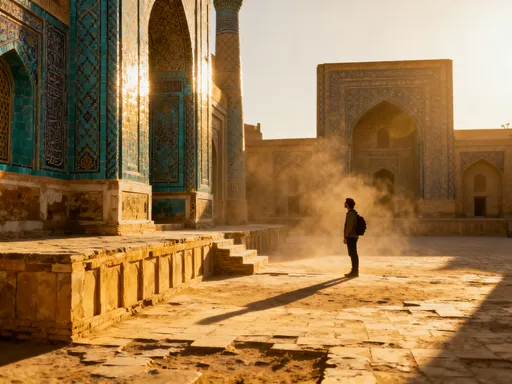
The Mir-i-Arab Madrasa, still functioning as a religious school, hums with quiet energy. Students in long robes move through its arched corridors, their footsteps echoing against thick walls that absorb sound and heat alike. The building’s facade is a symphony of geometric patterns and calligraphic inscriptions, each line of Arabic script carrying verses from the Quran and reminders of divine wisdom. Sunlight strikes the turquoise and cobalt tiles at different angles throughout the day, transforming the façade into a living canvas of shifting color. To stand in the central courtyard at midday, when shadows retreat beneath the iwan arches, is to feel the weight of centuries of devotion and learning.
Poi-Kalyan is more than a tourist site; it is a spiritual anchor. Locals still come to sit in the shade, whisper prayers, or simply reflect. For visitors, it offers a rare opportunity to witness Islam’s intellectual and architectural legacy not as a relic, but as a continuing tradition. The complex does not merely represent Bukhara’s past—it sustains its present.
Madrasas That Speak: Ulugbek and Abdulaziz Khan
Facing each other across a sunlit plaza just north of Poi-Kalyan, the Ulugbek Madrasa and the Abdulaziz Khan Madrasa form one of the most visually striking duos in Islamic architecture. Built nearly a century apart, they embody two eras of scholarly ambition and artistic refinement. The Ulugbek Madrasa, constructed in 1417 by the Timurid astronomer-king Ulugh Beg, was among the first great centers of learning in Central Asia. Its sober façade, marked by deep blue tiles and restrained ornamentation, reflects the scientific precision Ulugh Beg championed. Inside, the hujras—small student cells—line a quiet courtyard where silence amplifies the imagination of young minds once studying astronomy, mathematics, and philosophy.
Across the square, the Abdulaziz Khan Madrasa, completed in 1652, presents a bolder, more ornate aesthetic. Its façade bursts with gold-leaf details, intricate wood carvings, and vibrant mosaics depicting floral and celestial motifs. This was a statement of cultural revival under the Janid dynasty, a declaration that Bukhara remained a center of artistic and intellectual excellence. The two buildings, though stylistically different, engage in a silent dialogue across time and taste, a testament to the city’s evolving but unbroken commitment to knowledge.
Today, both madrasas are open to the public, no longer functioning as religious schools but repurposed as cultural spaces and museums. Yet their educational spirit lingers. Visitors can walk the same corridors where students once debated theology and cosmology, touch the same carved stucco walls, and gaze up at the same star-patterned ceilings. In one corner of the Ulugbek Madrasa, a small exhibit displays ancient manuscripts and astrolabes, tools that once helped scholars map the heavens. These are not distant curiosities—they are tangible links to a worldview in which science and faith were not at odds, but intertwined.
The preservation of these institutions speaks to Bukhara’s broader cultural philosophy: to honor the past not by freezing it, but by allowing it to breathe in new forms. Tourists are encouraged to walk quietly, speak softly, and remove their shoes when entering prayer spaces, reflecting a deep respect for the sanctity of these places. In doing so, they become temporary custodians of a legacy that transcends nationality and era.
Hidden Courtyards and Living Heritage
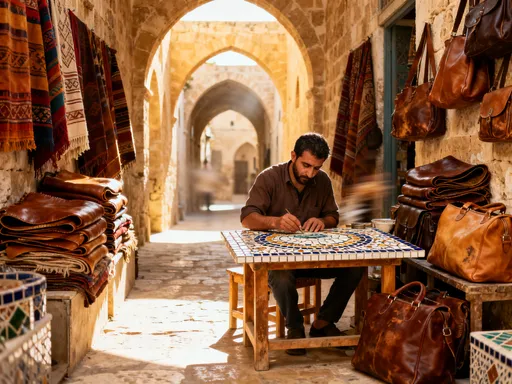
Beyond the grand monuments, Bukhara’s true magic unfolds in its hidden courtyards—intimate spaces tucked behind unassuming doors, where tradition is not performed but lived. These are the homes of artisans, families, and craftsmen who have preserved skills passed down through generations. In one such courtyard, a woodcarver sits cross-legged on a low stool, chiseling delicate arabesques into a panel of mulberry wood. The scent of fresh shavings fills the air, and the rhythmic tap-tap of his mallet blends with the distant call to prayer. This is not a demonstration for tourists; it is his livelihood, his art, his inheritance.
Similar scenes unfold across the city. In narrow alleys, women embroider silk with gold thread, their fingers moving with practiced ease. Potters shape clay on foot-powered wheels, crafting bowls and vases glazed in the traditional cobalt and white of Bukharan ceramics. These crafts are not relics—they are thriving industries, supported by both local demand and discerning travelers seeking authentic souvenirs. Many workshops welcome visitors, not as spectators, but as guests. A cup of green tea is often offered, and conversations flow easily, bridged by smiles and gestures when language fails.
One of the most rewarding experiences for visitors is participating in a home-based craft workshop. In a private courtyard near Tokai Tepa, a family-run studio teaches visitors the basics of suzani embroidery, a textile art unique to Central Asia. As hands fumble with needle and thread, the hostess shares stories of her grandmother, who stitched wedding cloths for the entire village. These moments are not curated—they are spontaneous, warm, and deeply human. They remind us that culture is not just in monuments, but in hands, voices, and daily rituals.
Responsible tourism plays a vital role here. When travelers purchase directly from artisans or stay in family-run guesthouses, they contribute to the sustainability of these traditions. Unlike mass-market souvenirs, handmade items carry the soul of their makers. By choosing authenticity over convenience, visitors become part of a quiet movement to preserve Bukhara’s living heritage—one stitch, one carving, one shared meal at a time.
The Magic of Lyabi-Hauz: Where Culture Breathes
No place in Bukhara captures the harmony of history and daily life quite like Lyabi-Hauz. Centered around a rectangular pool built in the 17th century, this plaza has long been a gathering place for locals and travelers alike. The name means 'by the water,' and the pool—once a vital water source—now serves as a mirror, reflecting the surrounding mulberry trees, wooden balconies, and the occasional stork’s nest atop a minaret. Benches line the edges, occupied by elders playing dominoes or backgammon, their laughter rising above the murmur of conversation.
In the late afternoon, the atmosphere shifts. Musicians arrive—often a trio with doira (frame drum), tanbur (long-necked lute), and dutar (two-stringed instrument)—and begin to play traditional Shashmaqam melodies. The music is haunting and lyrical, each note unfolding like a story. Travelers pause, some closing their eyes to listen, others sipping green tea from nearby cafes. These cafes, housed in restored 18th-century buildings, serve plov (rice with meat), samsa (baked pastries), and fresh naan, all prepared in wood-fired ovens just as they were centuries ago.
What makes Lyabi-Hauz extraordinary is that it is not a staged performance. The musicians are not paid by the city; they come because this is where people gather. The elders are not actors; they are grandfathers on their daily walk. The children chasing each other between tables are not part of a cultural show—they are simply playing. This is organic community life, uninterrupted by time. For visitors, it offers a rare privilege: to witness culture not as a display, but as a lived reality.
Evenings at Lyabi-Hauz are particularly enchanting. As the sun dips below the rooftops, the pool glows with the warm light of lanterns. Shadows stretch across the stone, and the air cools. Couples sit quietly, families share meals, and travelers from around the world exchange quiet smiles. In this moment, Bukhara feels not like a museum, but like a home—one that generously opens its doors to those who come with respect and open hearts.
Navigating the Old City: Practical Tips for Meaningful Exploration
Exploring Bukhara’s old city is best done on foot, allowing travelers to absorb its textures, sounds, and rhythms at a human pace. The historic center is compact, with most major sites within a 20-minute walk of each other. To avoid the midday heat, especially in summer, it is advisable to begin early—by 8:00 a.m.—when the streets are cool and the light is soft. Mornings also offer the best opportunities for photography, with golden sunlight illuminating the tilework and long shadows adding depth to alleyway scenes.
Dress modestly out of respect for local customs. While Bukhara is welcoming to foreigners, covering shoulders and knees is appreciated, particularly when visiting mosques or madrasas. Women may wish to carry a light scarf for entry into religious sites. Comfortable walking shoes are essential; the cobblestones are uneven, and days of exploration can be physically demanding.
Photography is generally permitted in public areas, but always ask permission before photographing people, especially in private courtyards or workshops. Some artisans may request a small fee for photos, which is a fair way to support their work. Avoid using flash inside historic buildings, as it can damage delicate surfaces over time.
One of the most valuable choices a traveler can make is to hire a local guide. Licensed guides, often fluent in English and deeply knowledgeable about history and culture, can transform a simple walk into a rich narrative experience. They know the stories behind the architecture, the meanings of calligraphic inscriptions, and the best times to visit each site. Their insights help travelers move beyond surface-level tourism to a deeper understanding of Bukhara’s soul.
Finally, practice slow travel. Resist the urge to check off every site in a single day. Instead, allow time to sit by the pool, share tea with a local, or simply watch the world pass by from a shaded bench. It is in these unhurried moments that Bukhara reveals itself—not as a list of attractions, but as a living, breathing city with a heartbeat all its own.
Why Bukhara Matters: A Timeless Reminder in a Fast-Moving World
In an age dominated by digital screens, instant communication, and constant motion, Bukhara stands as a quiet antidote. It does not offer adrenaline or spectacle, but something far more enduring: stillness, depth, and connection. This city reminds us that human civilization is not measured solely by technological progress, but by the continuity of culture, the preservation of wisdom, and the dignity of daily life. In its courtyards, we see how beauty and function can coexist. In its madrasas, we witness how knowledge can transcend generations. In its plazas, we experience how community can flourish without fanfare.
Bukhara’s significance extends beyond tourism. It is a guardian of identity—a place where Uzbek traditions are not performed for outsiders, but lived with quiet pride. It challenges the modern assumption that older is obsolete, proving instead that the past can inform the present with grace and purpose. For women, especially those balancing family, responsibility, and personal reflection, Bukhara offers a rare space to pause, to breathe, to remember what matters.
The city also exemplifies the power of preservation through use. Unlike places where heritage is locked behind ropes and glass, Bukhara’s monuments are lived in, worked in, celebrated in. This model of cultural sustainability—where history is not frozen but flowing—holds lessons for cities worldwide. It shows that progress need not mean erasure, that modernity can coexist with memory.
To visit Bukhara is not merely to see another country, but to reconsider one’s own life. It invites introspection: What parts of our past do we honor? What traditions do we carry forward? How can we slow down, connect more deeply, and live with intention? The answers may not come in words, but in the silence between footsteps on an ancient path, in the warmth of tea shared with a stranger, in the gaze of a dome that has watched centuries pass.
So let us step off the beaten path. Let us choose depth over speed, presence over distraction. Let us allow ancient cities like Bukhara to reshape our modern perspectives. For in their quiet strength, their enduring beauty, their living soul, we may just find a piece of ourselves we didn’t know was missing.