Where Art Meets Nature: Berlin’s Secret Green Masterpieces
You know that feeling when a city surprises you? I came to Berlin for the art—and stayed for the wild, unexpected beauty hiding in plain sight. Forget cold concrete; this city breathes through its parks, rivers, and forested edges. From graffiti-kissed walls blending into ivy-covered ruins to open-air galleries under pine canopies, Berlin redefines what a creative urban landscape can be. This is nature not tamed—but collaborating with art. And honestly? It’s mind-blowing.
The Unexpected Canvas: Berlin’s Natural Heartbeat
Berlin is not what you expect from a European capital. There are no perfectly manicured boulevards stretching endlessly into the horizon, no rigid grids of stone and steel that dominate the skyline. Instead, the city pulses with a different rhythm—one shaped by water, wind, and wild green spaces. Over one-third of Berlin’s total area is covered in parks, forests, lakes, and green corridors, forming a living network that threads through neighborhoods and history alike. This is not accidental; it is intentional, born from decades of urban planning that embraced nature as a co-creator rather than an obstacle.
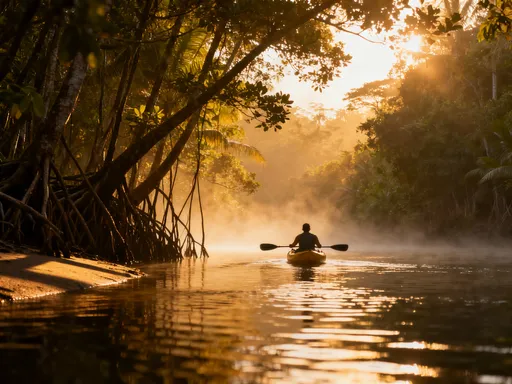
The Spree River, winding through the heart of the city, acts as both a historical artery and a modern-day sanctuary. Its banks are lined with willows and reeds, where herons stalk quietly at dawn and kayakers glide past remnants of Cold War bridges. Nearby, the Tiergarten—a vast inner-city park once designed as a royal hunting ground—now serves as a green lung for millions. Joggers, picnickers, and artists all share its shaded paths, where chestnut trees bloom in spring and golden light filters through in autumn. This balance between accessibility and serenity is no small feat in a city of 3.7 million people.
Equally vital is the Grunewald, a sprawling forest in the west that feels more like a northern woodland than an urban edge. Spanning over 3,000 hectares, it offers miles of trails, hidden clearings, and even small lakes where families swim in summer. Unlike many city forests that are carefully managed, the Grunewald allows certain areas to grow wild—fallen trees left to decompose, meadows allowed to flower freely. This acceptance of natural cycles reflects a broader philosophy in Berlin: that growth does not always mean construction, and beauty does not require control.
These green spaces are not just recreational—they are foundational. They shape how Berliners live, think, and create. The city’s reunification in 1990 left behind abandoned zones, vacant lots, and decommissioned infrastructure. Rather than rushing to rebuild, many communities chose to let nature reclaim these spaces. Over time, what emerged was a new kind of urban ecology: one where ivy creeps up forgotten walls, foxes roam near train tracks, and public art finds its voice among the trees. In this way, Berlin’s green spaces are not merely escapes from the city—they are integral to its identity, offering room for reflection, expression, and renewal.
Art in the Open Air: When Murals Meet Meadows
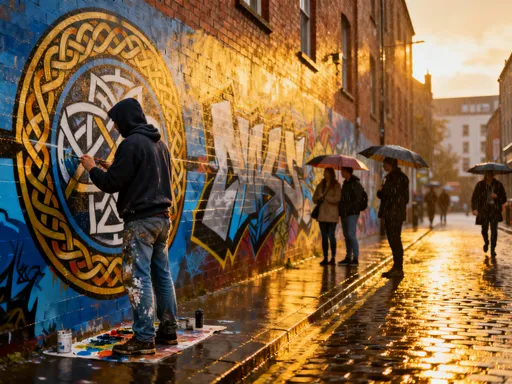
If Berlin has a global reputation, it is for its street art. The city is often called the graffiti capital of Europe, a place where walls speak in bold colors and unfiltered truths. But beyond the well-documented murals of Kreuzberg and Friedrichshain lies a quieter, more poetic evolution: the merging of street art with natural environments. Here, art does not fight against nature—it dances with it. Vines curl around painted figures, rain washes pigments into soil, and moss slowly claims spray-painted surfaces. This impermanence is not a loss; it is part of the message.
The East Side Gallery, a 1.3-kilometer stretch of the Berlin Wall preserved as an open-air gallery, is perhaps the most famous example. But few visitors notice how seamlessly it integrates with its riverside setting. The Spree flows gently beside it, reflecting murals like The Fraternal Kiss and My God, Help Me to Survive This Deadly Love. Ducks paddle beneath images of revolution and hope, creating a strange yet beautiful contrast between political gravity and natural calm. In spring, wildflowers bloom at the base of the wall; in autumn, leaves drift onto painted faces. The art remains powerful, but it is no longer static—it is part of a living landscape.
Lesser-known sites reveal even deeper collaborations. In abandoned railway yards, artists have painted on rusted metal sheets half-buried in soil, their messages fading as nature reclaims the land. In Mauerpark, once a death strip, tree trunks serve as rotating canvases for temporary installations—wooden masks, woven tapestries, or small sculptures tucked into bark crevices. Some artists use biodegradable paints, knowing their work will vanish with the seasons. Others carve into fallen logs or arrange stones in patterns visible only from above, turning the forest floor into a subtle, shifting exhibition.
This synergy between transience in nature and impermanence in street art speaks to a deeper truth about creativity. In a world obsessed with permanence—museums, monuments, digital archives—Berlin reminds us that some of the most moving art exists only for a moment. A mural washed away by rain, a sculpture overgrown by ivy, a poem scrawled on a birch tree and gone by winter—these are not failures. They are acts of faith in the present. And for the observer, they invite a different kind of attention: slower, more attentive, more grateful. In these spaces, art is not something to be owned or preserved—it is something to be witnessed, like a bird in flight or sunlight through leaves.
Tempelhofer Feld: The Park That Was a Runway
No place in Berlin embodies the city’s spirit of transformation quite like Tempelhofer Feld. Once one of Europe’s largest airports, Tempelhof was closed in 2008, leaving behind vast runways, hangars, and terminal buildings. For a time, its future was uncertain. Developers proposed high-rise complexes and luxury housing. But Berliners had another vision. In a landmark referendum, citizens voted to preserve the site as public green space—a decision that has since become a model of democratic urban planning.
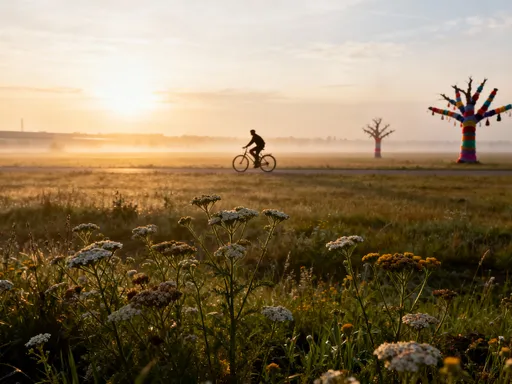
Today, Tempelhofer Feld is a 385-hectare park unlike any other. Its wide, open fields—former runways—invite kites, bicycles, and free-running children. Families grow vegetables in community garden plots; beekeepers tend hives near wildflower meadows; dog walkers stroll past patches of clover and dandelions. The air hums not with engines but with laughter, music, and the rustle of wind through tall grass. Yet even in this expansive openness, art finds its way in subtle, surprising forms.
Local artists have embedded installations throughout the park, turning infrastructure into inspiration. At one end, a sound sculpture made of metal pipes sings in the wind, its tones shifting with the weather. Elsewhere, trees have been “yarn-bombed” with colorful knitted sleeves—a whimsical nod to textile art and collective creativity. Temporary exhibits appear seasonally: wooden sculptures shaped like birds, mirror mosaics reflecting the sky, or light projections on abandoned control towers during winter nights.
What makes Tempelhofer Feld truly special is how art and ecology coexist without conflict. Community events blend performance with environmental awareness—open-air dance pieces choreographed around nesting birds, poetry readings held in garden sheds, or art workshops using only natural materials. School groups learn about pollinators while painting insect murals; volunteers restore native plants while discussing land art. This is not art imposed on nature, nor nature preserved despite art. It is a partnership—one where creativity enhances conservation, and conservation inspires creativity.
The park stands as a living testament to what cities can become when they prioritize people and nature over profit and concrete. In an era of rapid urbanization, Tempelhofer Feld offers a radical idea: that empty space is not wasted space. That silence has value. That the ground beneath our feet can be both a canvas and a sanctuary.
The Forest as Gallery: Art Trails in the Grunewald
Deep within the Grunewald, away from traffic and crowds, a quieter form of artistic expression unfolds. Here, the forest itself becomes a gallery—its paths lined not with white walls and spotlights, but with sculptures, sound pieces, and land art that emerge from the landscape. These works do not dominate; they listen. They respond to the wind, the seasons, the quiet pulse of the woods. Visitors who walk these trails are not just observers—they become part of an immersive experience where art, nature, and mindfulness intertwine.
One such trail, maintained by a local arts collective, features over twenty installations spread across a five-kilometer loop. A bench carved from driftwood invites rest and reflection. Stone circles echo ancient patterns, their meaning open to interpretation. A metal funnel embedded in a tree trunk amplifies the sound of rustling leaves, turning the forest’s whisper into music. Elsewhere, a suspended web of ropes and chimes moves with the breeze, creating soft, unpredictable harmonies. These pieces are not labeled or ticketed; they are discovered, often by accident, like secrets shared by the trees.
Guided “forest gallery” tours have grown in popularity, especially among families and wellness groups. Led by artist-naturalists, these walks combine ecological education with artistic interpretation. Participants learn about tree species while discussing how bark textures inspire printmaking. They pause at a moss-covered sculpture to talk about decay and regeneration. They close their eyes to listen to a sound installation and describe what emotions arise. These tours do not rush; they meander, allowing space for stillness and connection.
What makes this model so powerful is its accessibility. There are no entry fees, no opening hours, no dress codes. A mother pushing a stroller can pause at a wooden sculpture with her child. A retiree on a morning walk can sit and sketch a stone arrangement. A teenager with headphones can stumble upon a chime installation and smile, surprised by beauty in an ordinary moment. In this way, the forest gallery democratizes art—not as something elite or distant, but as a shared, evolving conversation between people and place.
The Grunewald’s role as both sanctuary and exhibition space challenges traditional notions of where art belongs. It proves that creativity does not require walls or climate control. It thrives in rain and wind, in silence and shadow. And perhaps most importantly, it reminds us that nature is not a backdrop for human expression—it is a participant.
Urban Lakes and Creative Currents: The Allure of Müggelsee and Tegeler See
Berlin’s lakes are more than summer escapes—they are creative hubs. Two of the largest, Müggelsee in the southeast and Tegeler See in the northwest, draw not only swimmers and boaters but also painters, musicians, and craft artists who set up temporary studios along their shores. These natural spaces offer something rare in urban life: uninterrupted light, open horizons, and the ever-changing play of water and sky. For creatives, they are ideal studios—free, inspiring, and alive with movement.
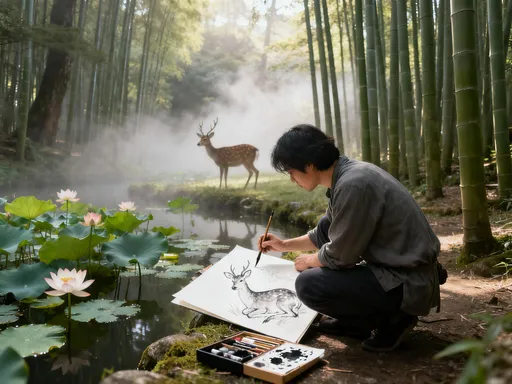
At Müggelsee, plein air painters arrive early to capture the morning mist rising off the water. Their easels dot the grassy banks, where reeds sway and dragonflies hover. The lake’s calm surface acts as a mirror, doubling the colors of sunrise and making every brushstroke a dialogue with reflection. Nearby, ceramicists fire small kilns using sustainable wood, crafting pieces inspired by local flora. Some embed crushed shells or sand into their glazes, literally making art from the landscape.
Tegeler See, with its forested edges and quieter atmosphere, attracts musicians and sound artists. On weekend afternoons, spontaneous performances emerge—a cellist playing beneath pine trees, a folk band strumming near a wooden pier, a group of singers harmonizing with the wind. During summer festivals, the lake hosts floating art installations: illuminated rafts shaped like fish, kinetic sculptures that spin with the current, or poetry readings broadcast from a boat. These events transform the water into a stage, where art flows as freely as the tides.
Local cafés and kiosks contribute to the creative ecosystem, often doubling as pop-up galleries. A simple beachside stand might display photographs of migratory birds, watercolor sketches of lilies, or handmade jewelry using recycled glass from the shore. Some host weekly artist meetups or poetry slams, turning casual gatherings into cultural moments. This informal network—unfunded, uncurated, yet deeply authentic—shows how nature nurtures not just individual creativity but community expression.
What unites these lake-based practices is their responsiveness to environment. Light, weather, and water are not obstacles—they are collaborators. A sudden rainstorm might wash a chalk drawing into the sand, but the artist smiles, knowing it was never meant to last. A gust of wind might scatter sheet music, but the musician adapts, improvising a new melody. In these moments, the boundary between art and nature dissolves. The lake does not merely inspire—it participates.
Gardens of Expression: From Prinzessinnengärten to Community Plots
In the heart of Kreuzberg, tucked behind brick buildings and cobblestone alleys, lies Prinzessinnengärten—a vibrant example of urban gardening as living art. What began as a temporary project on a vacant lot has become a pioneering model of eco-art and sustainable design. The garden’s planters are made from recycled materials—old shipping pallets, repurposed tires, even decommissioned bathtubs. Paths are laid with crushed stone and wood chips, and the layout follows artistic themes: spiral herb beds, color-coded flower zones, and vegetable plots arranged like mosaic tiles.
But Prinzessinnengärten is more than a garden. It is a cultural space. Weekly workshops teach composting, seed saving, and natural dyeing using homegrown plants. Poetry readings are held under sunflowers; film screenings take place on a wall made of straw bales; children paint murals on wooden boards that double as compost bins. The soil is not just fertile—it is expressive. Every element, from the tallest sunflower to the smallest bean sprout, becomes part of a larger narrative about sustainability, community, and beauty.
This fusion of horticulture and artistry has inspired similar projects across Berlin. In Neukölln, a former parking lot now hosts a community garden where murals cover the surrounding walls and sculptures made of reclaimed metal rise from flower beds. In Pankow, a school garden teaches students to grow food while creating seasonal installations—pumpkin lanterns in autumn, ice sculptures in winter, woven willow domes in spring. These spaces are not just about food production; they are about meaning-making.
What sets these gardens apart is their openness. They welcome everyone—seniors, children, newcomers, artists, retirees—with no requirement to “be creative.” You can simply sit on a bench, sip herbal tea, and watch bees pollinate lavender. Yet, in that stillness, something often stirs. A grandmother starts sketching the garden layout. A teenager builds a small sculpture from fallen branches. A couple writes a poem about the tomatoes they helped grow. The garden does not demand art—it invites it, gently, like sunlight through leaves.
In a world where art is often confined to institutions, these spaces reclaim creativity as a daily, communal act. They remind us that expression does not require a degree or a gallery. It can grow in a pot, bloom in a shared plot, flourish in the hands of someone who just wanted to plant a seed.
Why This Fusion Matters: The Future of Creative Cities
Berlin’s integration of art and nature is not just charming—it is essential. In an age of climate uncertainty, urban overcrowding, and digital saturation, the city offers a blueprint for how creativity and ecology can support each other. Access to green space is not a luxury; it is a catalyst for imagination, emotional well-being, and social cohesion. Studies have shown that time in nature reduces stress, improves focus, and enhances mood. When art is woven into these spaces, the benefits multiply. Creativity becomes not an escape from reality, but a way of engaging with it more deeply.
Yet this model is fragile. Pressures of development, rising land values, and commercialization threaten many of Berlin’s hybrid zones. Vacant lots are being paved over. Community gardens face eviction. Forest trails are restricted for safety or tourism. Without active protection, these spaces—so vital to the city’s soul—could disappear. Preserving them requires more than policy; it requires cultural commitment. It means valuing emptiness as much as construction, silence as much as noise, and impermanence as much as permanence.
Other cities are beginning to take note. From Copenhagen’s green roofs to Melbourne’s laneway art trails, urban planners are exploring ways to blend nature and creativity. But few have achieved Berlin’s depth of integration. Here, the relationship is not decorative—it is structural. Art does not merely adorn parks; it grows from them. Nature does not just inspire artists; it shapes the conditions for art to exist.
For the individual, this fusion invites a shift in perspective. It asks us to see cities not as concrete jungles to be conquered, but as evolving ecosystems where humans, nature, and creativity co-create meaning. It encourages us to walk slowly, to notice moss on a wall, to listen to wind in a sculpture, to plant a seed and leave a poem. In these small acts, we participate in something larger—a vision of urban life that is not just sustainable, but soulful.
Berlin teaches us that beauty does not have to be preserved behind glass. It can grow in cracks, flow in rivers, bloom in shared soil. It can be temporary, imperfect, alive. And sometimes, when art and nature meet in the quiet corners of a city, they remind us what it means to be human—not in spite of the wild, but because of it.